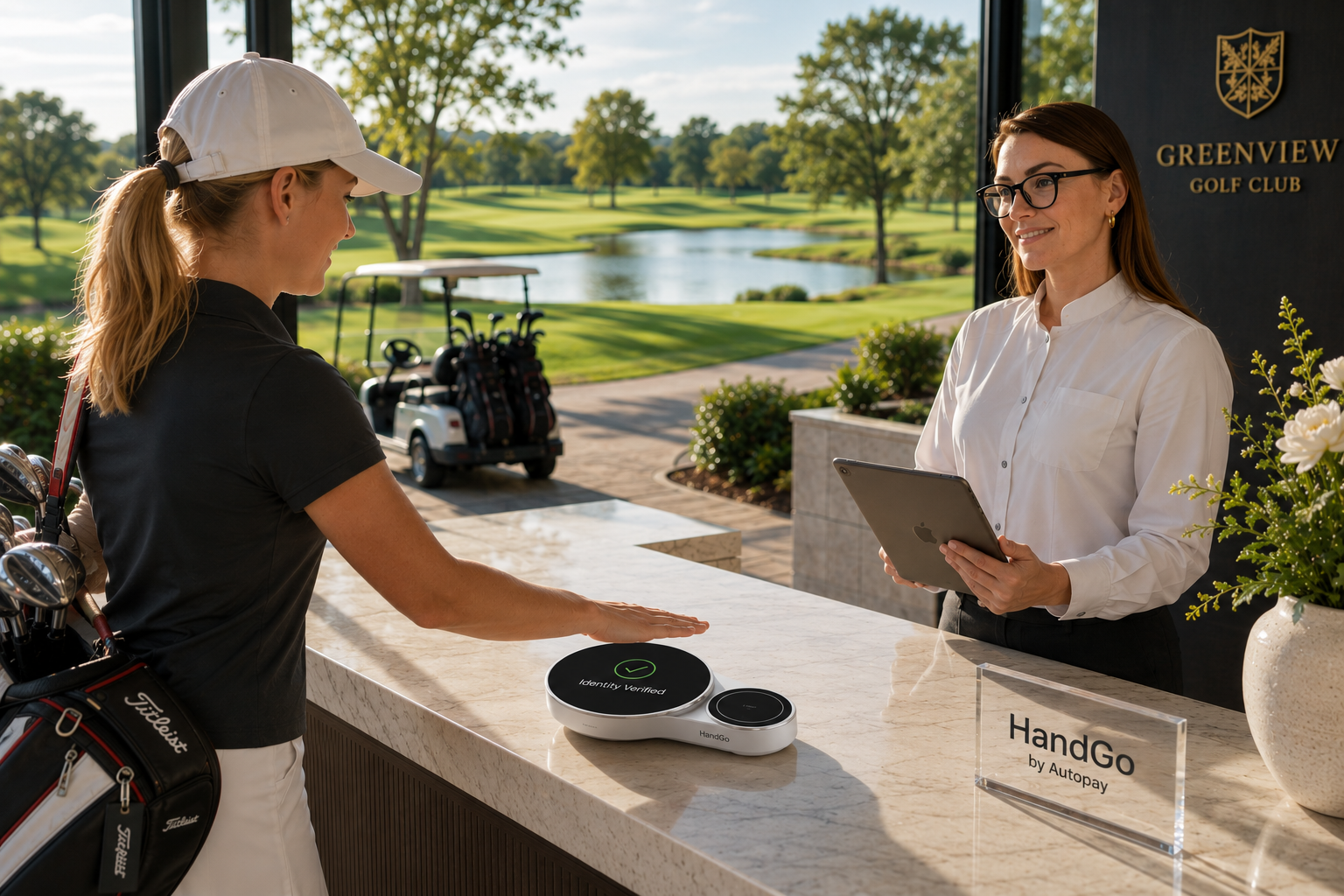
One round. One hand.
From the first tee to the eighteenth hole: access, purchases, and recognition from a single gesture. No wallet. No card. No phone.
The course already trusts the member. Now the technology can too.
Golf is a game of unhurried focus, yet a round is still interrupted by friction the player never asked for: a card left in the locker, a glove pulled off to tap a terminal, a name spelled out again at the desk.
HandGo removes it. The palm becomes entry, locker, cart, and tab, recognized across the property from arrival to settlement. The hand triggers the moment. It never stands in the middle of it.
Five moments where the round stops.
Gloves on, wallet in the bag: paying on the course means stopping the round.
A card or phone carried through eighteen holes just for a drink and a sleeve of balls.
Members re-introduced to new staff who don't yet know them.
Lost lockers, forgotten combinations, shared or replaced cards.
Guest spend that slips between the cart, the bar, and the desk.
One enrollment removes all five.
See the roundOne enrollment. The whole day flows.
A player enrolls once: both hands scanned, a payment method linked. After that, every touchpoint recognizes them. On the course, readers take the bare trailing hand, so the glove never comes off.
Balls in hand at the range
Basket on screen, palm placed, dispensed in under five seconds. Live, in production.
Nothing comes off
The glove stays on. Readers take the bare trailing hand, and nothing slows down.
Before the round
- EntryClubhouse doors recognize the member at approach.
- Green feeConfirmed and settled at the desk in one gesture.
- LockerOpens to the palm; no combination, no key.
- Pro shop & rentalBalls, glove, clubs, cart: charged to the account, hands free.
On the course
- Driving range LiveBasket on screen, palm placed, balls in hand in under five seconds.
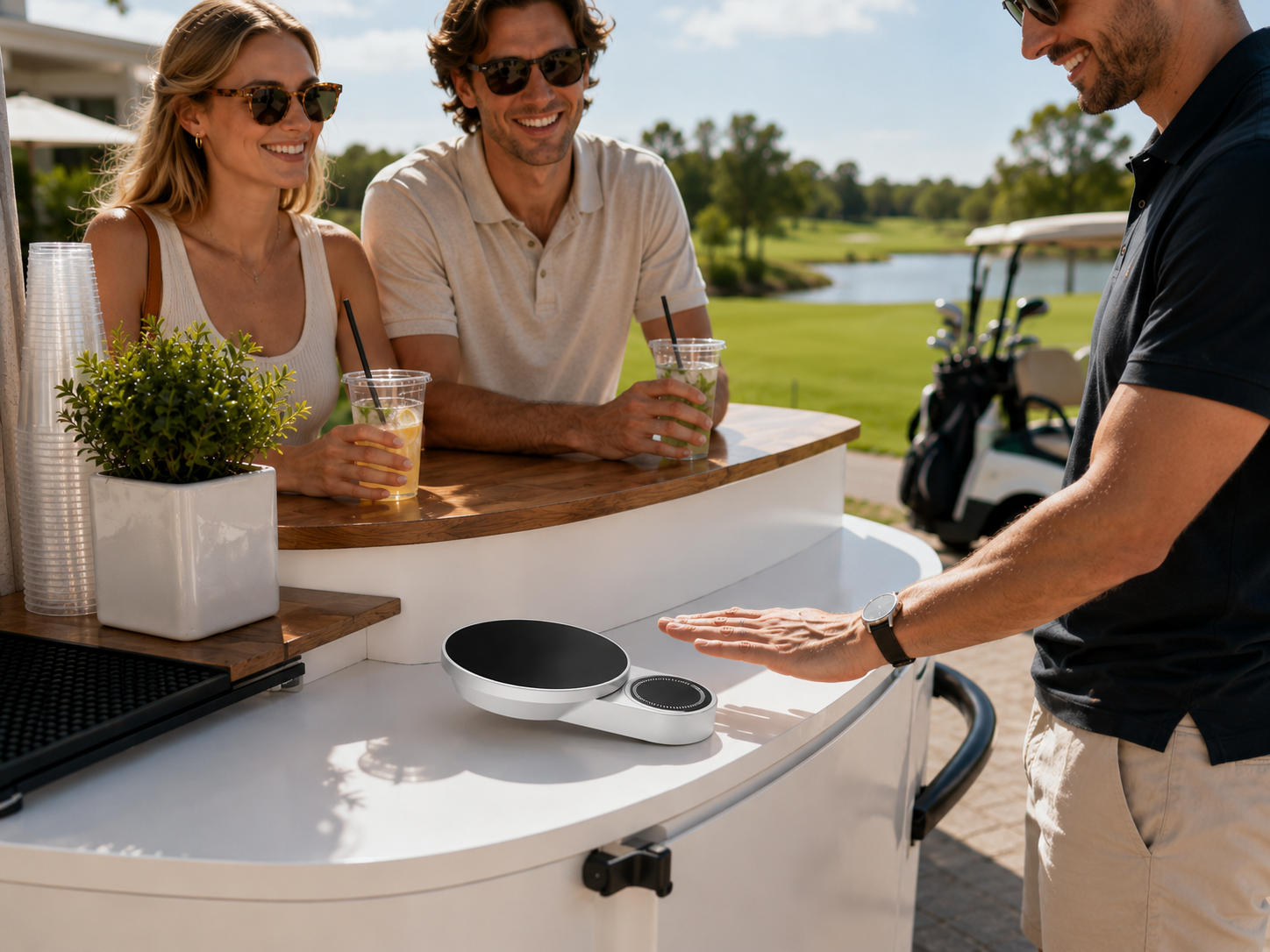
- Halfway house & cartA drink at the turn or mid-round, settled with the trailing hand.
After the round
- The 18thFood and drinks added to the running tab.
- ExitThe whole day closed and reconciled with one gesture.

Built for the way clubs actually operate.
Private & country clubs
Membership becomes recognition, not a card; spend settles to the account.
Resort & destination
Room to range to restaurant on one identity.
Daily-fee & public
Faster desks and ranges at peak hours.
Driving ranges
Self-serve, cashless dispensing and bay access, already proven.
Multi-site operators
One identity across every course, with reciprocal recognition.
Events & tournaments
Guest and corporate spend captured cleanly across a single day.
Two sides of the same gesture.
For players
- Recognized, not interrogated.
- Nothing to carry. Your hand is your membership.
- The glove stays on. Readers take the bare trailing hand.
- One identity across every course in the group.
- Real privacy: the vein pattern is inside the hand, invisible to any camera.
For operators
- More on-course spend: purchases happen when reaching for a card would have stopped them.
- Faster desks and ranges: up to half the service time removed at peak touchpoints.
- No cards to issue, lose, share, or counterfeit.
- Verified billing end to end, from the cart to the 18th.
- A premium, device-free signal that reinforces the club.
Recognition you choose. Privacy you keep.
Facial recognition is surveillance: a face can be captured from any camera, at any distance, without consent. Palm vein works the other way. The pattern is inside the hand, impossible to photograph or lift from a database, and read only on a deliberate gesture. Data is encrypted end-to-end and stored as tokens, never raw scans.

Less waiting. More playing.
less average service time per player at desks, ranges, and counters
average biometric match time
to enter, pay, or verify, even through a glove, in any weather
touchless, first tee to last
Proven where it matters first.
Biometric ball purchasing already running on the busiest, most repeat-driven touchpoint in golf.
Phone-free access proven across elite fitness, wellness, and private members' venues.
Every other touchpoint extends the same proven palm pay-and-access model.
Built on infrastructure handling over a billion transactions a year, certified to banking standards.
We didn't guess what drives adoption. We tested it.
Before a single reader goes live, we modeled how golfers actually decide, isolating one factor at a time across thousands of simulated decisions, then confirming the direction in the field. Three findings shape how HandGo is deployed on a course.
What pulls players to the palm
- A dedicated "hand-only" fast lane: the single strongest pull.
- When the phone isn't an option: dead battery, no signal, wet hands.
- A short path to the first successful use.
- A cashless environment.
- Hands full, on the move: the range and the beverage cart score highest of all.
What holds them back
- Habit and hurry: people drift back to what they know. The honest brake isn't fear of biometrics; it's routine.
- An effortless incumbent: against "just say your name," speed alone doesn't win; against tap-to-pay, it does.
- First-time enrollment: the one scan-and-link step. The barrier is the moment, not the person.
- A more cautious, older player.
What doesn't matter
- Privacy worry: close to zero effect. The same players already use Face ID.
- The amount, the queue, "my phone's right here."
- Who the player is: context outweighs persona by roughly four to one.
Over 20,000 simulated decisions. Then the field confirmed it.
Over 20,000 simulated decisions means repeated draws of described situations through a model of human cognition, not 20,000 people. The direction was confirmed independently by the field pilot.
Modeled across 20,000+ decisions, then confirmed live, in the field.
HandGo × Golf Park
A player's entire journey, held together by a single hand: from one-time registration to closing out the day. Open any step to see what the player does, the HandGo function and the device.
EntryOne-time Registration Verification
Scan of both hands at the large device, linking identity and payment card.
Step 01 Reception / entrance AccessVerification
Recognition and club entry with a single gesture, no membership card to show.
Step 02 Green fee Payment
Confirmation and payment for the round at reception.
Step 03 Locker Access
Unlocking the changing-room locker before getting changed.
Step 04 Pro shop Payment
Buying balls, tees and gloves at the counter.
Step 05 Rental PaymentAccess
Picking up clubs or trolley, rental authorization.
Step 06 Melex · pickup Access
One palm on the reader starts the rental session. After that, you drive freely.
Step 07Deployed Driving range Payment
Pick a basket on the dispenser screen and place your palm, balls in hand in under 5 s.
Step 08 Halfway house Payment
A snack and a drink at the turn, without breaking your rhythm.
Step 09 Beverage cart Payment
A purchase from the cart mid-round, hands full of gear.
Step 10 Restaurant Payment
Food and drinks after the round, added to the tab.
Step 11 Exit Payment
Closing out and settling the whole day with a single gesture.
One gesture. The whole round.
The hand launches the process. It never stands in the middle of it.
We onboard both hands, so the player always uses the one that is bare. On the course the readers accept the lower hand, so the glove on the lead hand never has to come off.
Onboarding only via device
First registration happens only on the large, stationary device (scan of both hands + card linking). The app is optional and not required to use the system.
The range is proof, not a hypothesis
Biometric payment at the driving range is live in production. The rest of the journey extends this proven pay-without-a-wallet pattern to the remaining touchpoints.
Three devices, three logics
Large: one per venue, for registration. Wall-mounted: fixed points (entrance, locker, counter, dispenser). Portable: mobile points (beverage cart, halfway, table service).

Bring the whole round into one gesture.
Interested in HandGo for your course, club, or group? Talk to us about a pilot, starting where the proof already is.